
AI Voice Agents for Small Business: Answer Every Call Without Hiring
Discover how AI voice agents help small businesses answer every call, book appointments, and handle FAQs around the clock — without the cost of a full-time receptionist.
The Missed Call Problem
Every missed phone call is a missed opportunity. For small businesses, the math is brutal. Studies consistently show that 60 to 80 percent of callers will not leave a voicemail — they will simply call the next business on the list. If you are a plumber, a dentist, a restaurant owner, or a real estate agent, those missed calls translate directly into lost revenue.
The traditional solution is hiring a receptionist or a call answering service. A full-time receptionist costs $35,000 to $45,000 per year in salary alone, plus benefits. Virtual receptionist services charge $1 to $2 per minute, which adds up quickly for businesses that handle dozens of calls daily. Neither option scales well, and both come with human limitations — lunch breaks, sick days, turnover, and inconsistent quality.
AI voice agents offer a fundamentally different approach. They answer every call instantly, handle routine conversations with natural-sounding speech, and route complex situations to your team with full context. They work 24 hours a day, 365 days a year, at a fraction of the cost.
What AI Voice Agents Actually Are
An AI voice agent is not a phone tree. It is not a robotic recording that says "press 1 for sales, press 2 for support." It is a conversational AI system that understands natural speech, responds in real time, and completes tasks during the call.
When a customer calls your business, the AI voice agent picks up within one ring. The caller speaks naturally — "I need to book an appointment for Thursday afternoon" or "What time do you close today?" — and the agent understands the request, pulls the relevant information from your business systems, and responds conversationally.
The technology behind this has matured significantly in the last two years. Modern voice agents use large language models for understanding context, speech-to-text for hearing the caller, and text-to-speech for responding with natural-sounding voices. The result is a conversation that feels remarkably human. Most callers cannot tell the difference during routine interactions.
What a Voice Agent Handles for Your Business
Appointment Booking and Scheduling
This is the highest-impact use case for most service businesses. The voice agent connects to your scheduling system — Google Calendar, Calendly, or your industry-specific software — and books appointments in real time during the call. It checks availability, confirms the time with the caller, and sends a confirmation via text message. No back-and-forth, no phone tag, no manual data entry.
For businesses that rely on appointments — salons, medical offices, home service companies, consultants — this alone can justify the investment. Every call that would have gone to voicemail now becomes a booked appointment.
After-Hours Call Handling
Most small businesses close their doors at 5 or 6 PM, but customer needs do not stop at closing time. A homeowner discovers a leak at 9 PM. A patient needs to reschedule a morning appointment at 7 AM. A customer wants to place a catering order on Sunday afternoon.
An AI voice agent handles these calls exactly the same way it handles daytime calls. It answers questions, books appointments for the next available slot, captures detailed messages with caller information, and sends you a summary so you are prepared when you start your day. Combined with an AI chatbot on your website, you create a system where customers can reach you through any channel at any time.
FAQ and Information Requests
A large percentage of incoming calls are simple informational requests. What are your hours? Where are you located? Do you accept insurance? How much does a basic service cost? What is your cancellation policy?
The voice agent is trained on your business data and answers these questions accurately and instantly. This frees your staff from the repetitive task of answering the same ten questions dozens of times per day. They can focus on the work that actually requires human expertise and judgment.
Call Routing and Warm Transfers
Not every call should be handled by AI. When a caller has a complex issue, an urgent situation, or simply wants to speak to a human, the voice agent recognizes this and transfers the call to the right person on your team. The critical difference is that it performs a warm transfer — passing along the caller's name, the reason for their call, and any information gathered during the conversation. Your team member picks up fully informed, and the caller does not have to repeat themselves.
ROI Comparison: Voice Agent vs. Receptionist
The financial case for AI voice agents is straightforward when you compare the costs:
- Full-time receptionist: $35,000 to $45,000 per year in salary, plus $8,000 to $15,000 in benefits, payroll taxes, and overhead. Works 40 hours per week. Handles one call at a time. Takes vacation, sick days, and breaks.
- Virtual receptionist service: $200 to $1,500 per month depending on call volume. Quality varies by provider. Limited availability for after-hours coverage. Often requires scripts that feel impersonal.
- AI voice agent: $200 to $800 per month for most small businesses. Available 24/7/365. Handles multiple simultaneous calls. Consistent quality on every interaction. Scales up instantly during high-volume periods.
For a business that misses 10 calls per week and each call represents an average of $150 in potential revenue, that is $78,000 per year in missed opportunities. Even capturing half of those calls through an AI voice agent pays for the technology many times over.
Use Cases by Industry
Home Services
Plumbers, electricians, HVAC companies, and landscapers live and die by the phone. When a customer has an emergency, they call the first company they find and hire whoever answers. An AI voice agent ensures you always answer first. It captures the caller's problem, location, and urgency level, then either books a service call or escalates to your on-call technician.
Healthcare and Dental Practices
Patients call to book appointments, confirm insurance coverage, ask about procedures, and request prescription refills. The voice agent handles scheduling and informational calls while routing clinical questions to your staff. It also sends appointment reminders and handles rescheduling, reducing your no-show rate significantly. These are exactly the types of automations that transform small businesses.
Restaurants and Hospitality
Phone orders, reservation requests, questions about hours and menu items, and catering inquiries make up the majority of restaurant calls. An AI voice agent handles all of these during your busiest hours when staff cannot afford to step away from the floor. For restaurants already using an AI chatbot for online orders and reservations, adding a voice agent creates complete coverage across every customer touchpoint.
Real Estate
Agents miss calls constantly because they are in showings, meetings, or driving between properties. A voice agent captures lead information, answers questions about listings, and schedules showings directly on the agent's calendar. The speed advantage matters — responding to a real estate lead within five minutes makes you 21 times more likely to qualify that lead compared to waiting 30 minutes.
Professional Services
Law firms, accounting practices, and consulting businesses depend on client relationships that start with a phone call. The voice agent provides a professional first impression, captures case details or project requirements, and schedules consultations. It ensures no potential client hears a voicemail greeting and moves on to a competitor.
Getting Started with AI Voice Agents
Implementing a voice agent is less complex than most business owners expect. Here is the typical process:
Step 1: Map your call patterns. Track your incoming calls for two weeks. What are callers asking? How many calls do you miss? When do most calls come in? This data shapes how the voice agent is configured.
Step 2: Build your knowledge base. Compile the information the agent needs — services, pricing, hours, policies, FAQs, scheduling rules, and escalation criteria. The more complete this is, the more capable the agent will be from day one.
Step 3: Configure and train. The voice agent is set up with your business information, connected to your scheduling and CRM systems, and tested with real-world call scenarios. This typically takes one to two weeks.
Step 4: Launch with a safety net. Start by routing after-hours calls to the voice agent while handling daytime calls normally. Monitor the conversations, refine responses, and gradually expand coverage as confidence builds.
Step 5: Optimize and expand. Once the core voice agent is running well, add capabilities — outbound appointment reminders, post-service follow-up calls, and integration with your automation workflows for seamless data flow across your business.
Common Questions
"Will customers be frustrated talking to AI?" The data says no. Studies show that 67 percent of customers prefer self-service options over speaking with a human for routine requests. What frustrates customers is not getting an answer at all — which is exactly what happens when calls go to voicemail.
"What about accents or background noise?" Modern speech recognition handles accents, dialects, and moderate background noise with high accuracy. The technology has improved dramatically and continues to improve. Edge cases that the AI cannot parse get routed to your team.
"Can it handle my specific industry?" AI voice agents are trained on your business data and configured for your specific workflows. Whether you are a veterinary clinic, a law firm, or an auto repair shop, the agent is customized to your terminology, services, and processes.
"What happens if the AI makes a mistake?" Every system includes fallback protocols. If the agent is uncertain about a response, it acknowledges the limitation and transfers to a human. Call recordings and transcripts let you review interactions and continuously improve the system.
The Bigger Picture
AI voice agents are not about replacing your team. They are about making sure your business never misses an opportunity because nobody was available to pick up the phone. Your staff handles the complex, high-value conversations that require human empathy and expertise. The AI handles the rest — consistently, instantly, and at scale.
The businesses that adopt this technology now gain a compounding advantage. Every call answered is a potential customer captured. Every appointment booked automatically is time your team spends on higher-value work. Over months, that adds up to a significant edge over competitors who are still letting calls ring through to voicemail.
Ready to stop missing calls and start capturing every opportunity? Schedule a free consultation and we will map out how an AI voice agent fits your specific business.
Get AI tips for your business
Join small business owners getting weekly insights on AI automation, chatbots, and growth strategies. No spam, unsubscribe anytime.
Related Articles
How Small Businesses Are Using AI to Transform Customer Service
Discover how small businesses use AI chatbots, voice agents, and automation to deliver fast, consistent customer service — without a large support team.
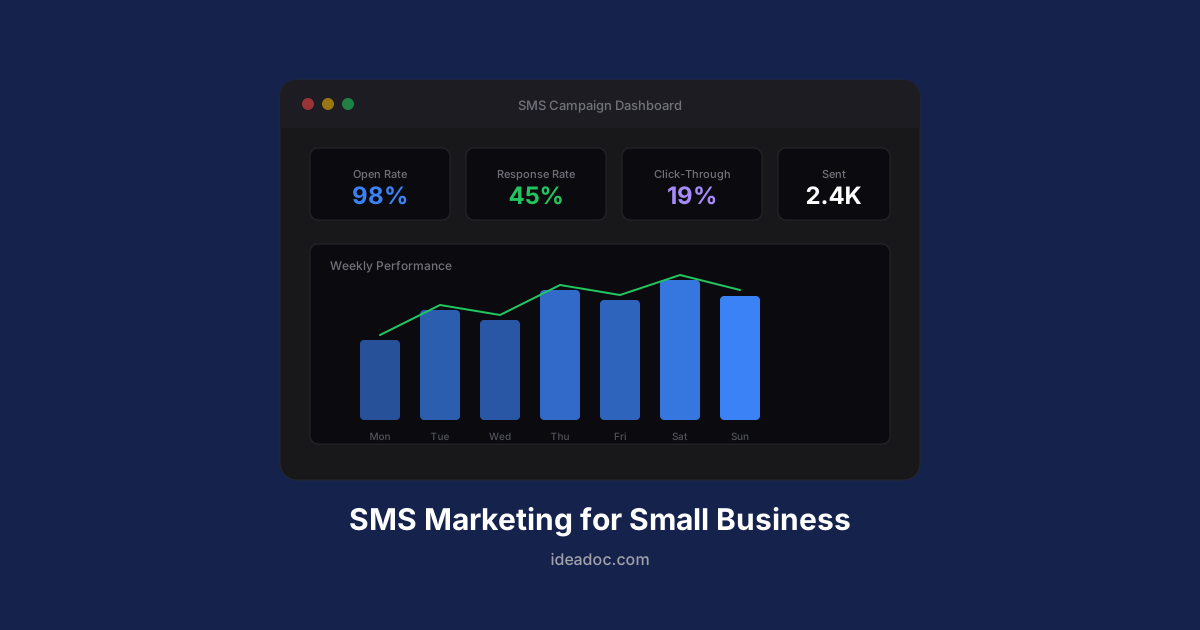
SMS Marketing for Small Business: 98% Open Rates and How to Get Started
SMS marketing delivers 98% open rates and 45% response rates — far outperforming email. Learn how small businesses can use text message campaigns for appointment reminders, promotions, and review requests.
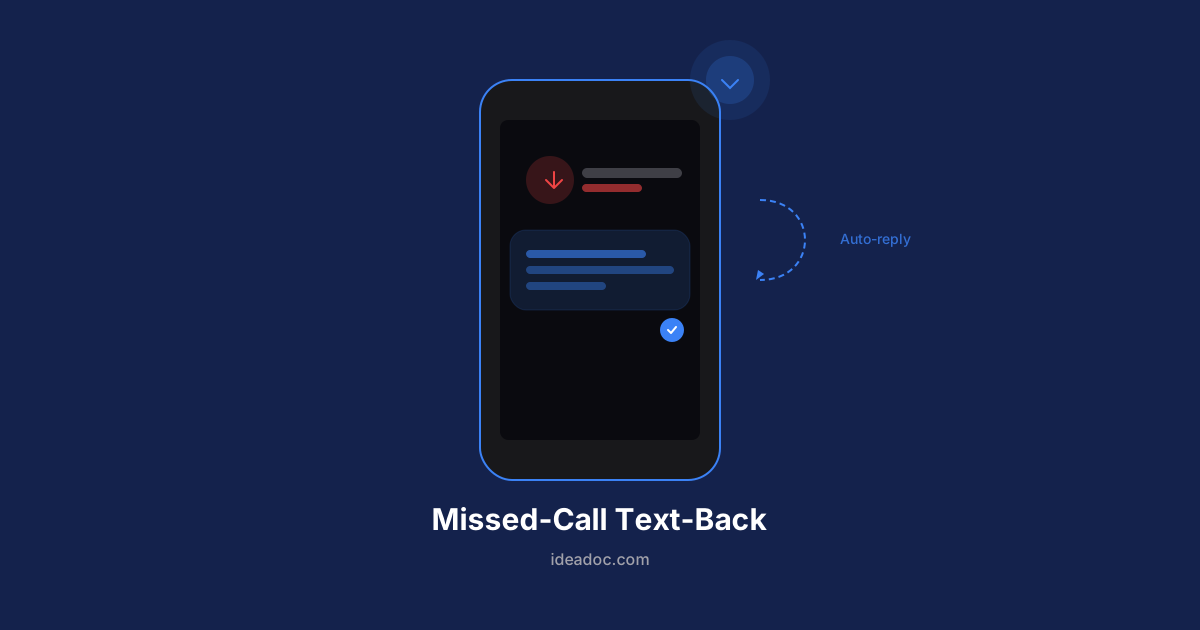
How Missed-Call Text-Back Can Recover $10K+/Year in Lost Revenue
Most small businesses miss 30-60% of inbound calls. Missed-call text-back automatically texts callers you can't answer — recovering leads that would otherwise go to your competitor.