
Local SEO in 2026: How AI Content Strategy Beats Traditional SEO
Why traditional SEO tactics are losing ground in 2026 and how AI-powered content strategy builds topical authority that dominates local search results.
The Old SEO Playbook Is Broken
If your SEO strategy still looks like it did three years ago — stuff keywords into a few pages, build some backlinks, and wait — you are falling behind. Google's algorithm has fundamentally changed how it evaluates websites, and the businesses winning local search in 2026 are doing something very different.
The shift is toward topical authority. Google no longer just matches keywords to pages. It evaluates whether your website demonstrates deep, comprehensive expertise on the topics related to your business. A plumber who publishes 40 genuinely helpful articles about plumbing problems, maintenance, and home improvement will outrank a competitor with a keyword-stuffed service page, even if the competitor has more backlinks.
The challenge for small businesses has always been producing enough quality content to build that authority. You are running a business. You do not have time to write two blog posts a week. This is where AI-powered content strategy changes the equation.
What Google Wants in 2026
Topical Authority Over Keyword Density
Google's understanding of language has become remarkably sophisticated. The search engine no longer needs exact keyword matches to understand what a page is about. It understands concepts, relationships between topics, and the overall depth of a website's coverage.
What this means for your business:
- A single page targeting "best plumber in Austin" is no longer a strategy. Google wants to see that your site covers the full spectrum of plumbing-related topics
- Content clusters — groups of related articles that link to each other — signal expertise more effectively than isolated pages
- The businesses ranking at the top of local search results consistently have 3 to 5 times more content than their competitors
Experience, Expertise, Authority, Trust (E-E-A-T)
Google's quality guidelines emphasize E-E-A-T as a framework for evaluating content. For local businesses, this translates to:
- Experience: Content that reflects real-world experience serving customers in your area
- Expertise: Detailed, accurate information that demonstrates professional knowledge
- Authority: Other credible sites referencing or linking to your content
- Trust: A website that is technically sound, secure, and transparent about who you are
AI content strategy does not replace E-E-A-T — it amplifies it. The AI handles the heavy lifting of research, drafting, and structuring content, while your real expertise and experience shape the final product into something genuinely valuable.
Core Web Vitals Still Matter
Technical SEO has not gone away. A website that loads slowly, shifts layout unexpectedly, or responds sluggishly to user interactions still gets penalized in rankings. All the great content in the world will not help if your site delivers a poor user experience.
This is why content strategy and website performance are not separate conversations. They are two halves of the same strategy. A fast, well-structured website multiplies the value of every piece of content you publish.
How AI Content Strategy Works
AI content strategy is not about letting ChatGPT write your blog posts and clicking publish. That approach produces generic, mediocre content that neither Google nor your potential customers find valuable. Effective AI content strategy is a structured process that uses AI as a tool, not a replacement for expertise.
Step 1: Topical Mapping
The first step is mapping every topic relevant to your business and your customers' questions. For a home services company, this might include:
- Service-specific topics (drain cleaning, water heater repair, bathroom remodeling)
- Problem-focused topics (why is my water heater making noise, how to prevent frozen pipes)
- Seasonal topics (winterizing your plumbing, spring maintenance checklist)
- Location-specific topics (water quality issues in your city, local building codes)
- Comparison and decision topics (tankless vs traditional water heaters, when to repair vs replace)
AI tools can analyze your competitors' content, search query data, and industry databases to generate a comprehensive topical map in hours. Doing this manually would take weeks.
Step 2: Content Cluster Design
Once you have a topical map, the next step is organizing it into content clusters. Each cluster has:
- A pillar page — a comprehensive overview of a broad topic (e.g., "Complete Guide to Water Heater Maintenance")
- Supporting articles — focused pieces that go deep on subtopics (e.g., "5 Signs Your Water Heater Needs Replacement," "Tankless Water Heater Pros and Cons")
- Internal links connecting every piece in the cluster, signaling to Google that your site covers the topic comprehensively
This structure is what builds topical authority. Google sees a website that covers water heater maintenance from every angle and concludes that this business is an authority on the subject.
Step 3: AI-Assisted Content Production
This is where AI accelerates what used to be the bottleneck. For each piece of content:
- AI generates a detailed outline based on search intent, competitor analysis, and your topical map
- AI drafts the initial content, incorporating relevant keywords, proper heading structure, and internal linking opportunities
- A human expert reviews, edits, and adds real-world experience. This is the critical step that separates effective AI content from generic AI output
- Schema markup is added to help Google understand the content's structure and purpose
- The content is published on a technically optimized platform that delivers fast page loads and proper indexing
A small business that might have published 2 articles per month can now publish 8 to 12, each with the quality and depth that Google rewards. The AI handles the 70 percent of work that is research and structure. The human adds the 30 percent that is insight, experience, and authenticity.
Step 4: Ongoing Optimization
AI content strategy is not set-and-forget. The process includes:
- Performance monitoring — tracking which content ranks, which generates traffic, and which converts visitors into leads
- Content updates — refreshing existing articles with new information, better structure, or additional depth based on performance data
- Gap analysis — identifying new topics your competitors are covering that you have not addressed yet
- Seasonal adjustments — publishing time-sensitive content ahead of seasonal demand
Schema Markup: The Technical Multiplier
One of the most overlooked elements of local SEO is structured data markup. Schema markup is code that explicitly tells Google what your content is about — your business name, services, location, reviews, FAQs, and more.
For local businesses, the right schema markup can trigger rich snippets in search results: star ratings, FAQ dropdowns, service lists, business hours, and map pins. These enhanced listings get significantly higher click-through rates than plain text results.
Key schema types for local businesses:
- LocalBusiness — your business identity, address, phone, hours, and service area
- Service — each service you offer with descriptions
- FAQ — frequently asked questions that can appear directly in search results
- Article — blog posts with author, publish date, and topic categorization
- Review — customer reviews and aggregate ratings
Schema markup is something AI tools can help generate quickly and consistently across your entire site. We cover this topic in depth in our guide to schema markup for small businesses.
Google Business Profile: Your Local SEO Foundation
No local SEO strategy is complete without an optimized Google Business Profile (GBP). This is the listing that appears in Google Maps and the local pack — the map results that show up for location-based searches.
GBP optimization essentials:
- Complete every field — business name, category, description, hours, phone, website, service area, attributes
- Add photos regularly. Businesses with more than 100 photos get 520 percent more calls than the average business, according to Google's own data
- Respond to every review — positive and negative. Response rate and speed influence your local ranking
- Post updates weekly. Google Business Profile posts are a free visibility tool that most businesses ignore
- Use the Q&A section proactively. Add your own frequently asked questions before customers do
AI tools can help draft review responses, generate GBP posts, and maintain a consistent publishing schedule — tasks that are individually small but collectively time-consuming.
Local Link Building That Actually Works
Backlinks remain a ranking factor, but the approach that works for local businesses is very different from enterprise SEO:
- Local business directories — claim your listing on every relevant directory with consistent name, address, and phone number (NAP consistency)
- Local partnerships — partner with complementary businesses and link to each other. A real estate agent linking to a home inspector, for example
- Community involvement — sponsor local events, join the chamber of commerce, participate in local charities. These organizations link to their sponsors and members
- Local content — write about local topics that naturally attract links from local news sites and blogs
- Supplier and vendor pages — if your suppliers or tool manufacturers have partner directories, get listed
The key insight is that local link building is about relationships, not outreach emails to strangers. AI can help identify opportunities by analyzing your competitors' backlink profiles, but the relationship-building is inherently human.
The Compound Effect
The reason AI content strategy outperforms traditional SEO is the compound effect. Each piece of content you publish strengthens every other piece. Each content cluster reinforces your topical authority across the domain. Each schema markup implementation makes Google's job easier, which it rewards with better visibility.
Traditional SEO tries to rank individual pages for individual keywords. AI content strategy builds a comprehensive web of authority that lifts your entire domain.
A business that commits to this approach for 6 to 12 months will typically see:
- 30 to 50 percent increase in organic search traffic
- Higher rankings for competitive local keywords that were previously out of reach
- More rich snippet appearances in search results
- Increasing returns over time as topical authority compounds
Getting Started
You do not need to implement everything at once. A practical starting point:
- Audit your current content. How many pages does your site have? How do they compare to your top competitors? Identify the gaps
- Choose one service area to build your first content cluster around
- Ensure your website is technically sound — fast load times, mobile-friendly, proper structure. If it is not, fix the foundation first with a modern web development approach
- Start publishing consistently. Two to four quality pieces per month is a realistic pace for most small businesses using AI-assisted workflows
If you want to accelerate the process, our SEO and content team builds complete AI content strategies for local businesses — topical maps, content clusters, schema implementation, and ongoing optimization. Contact us for a free content audit and we will show you exactly where the opportunities are in your market.
Get AI tips for your business
Join small business owners getting weekly insights on AI automation, chatbots, and growth strategies. No spam, unsubscribe anytime.
Related Articles
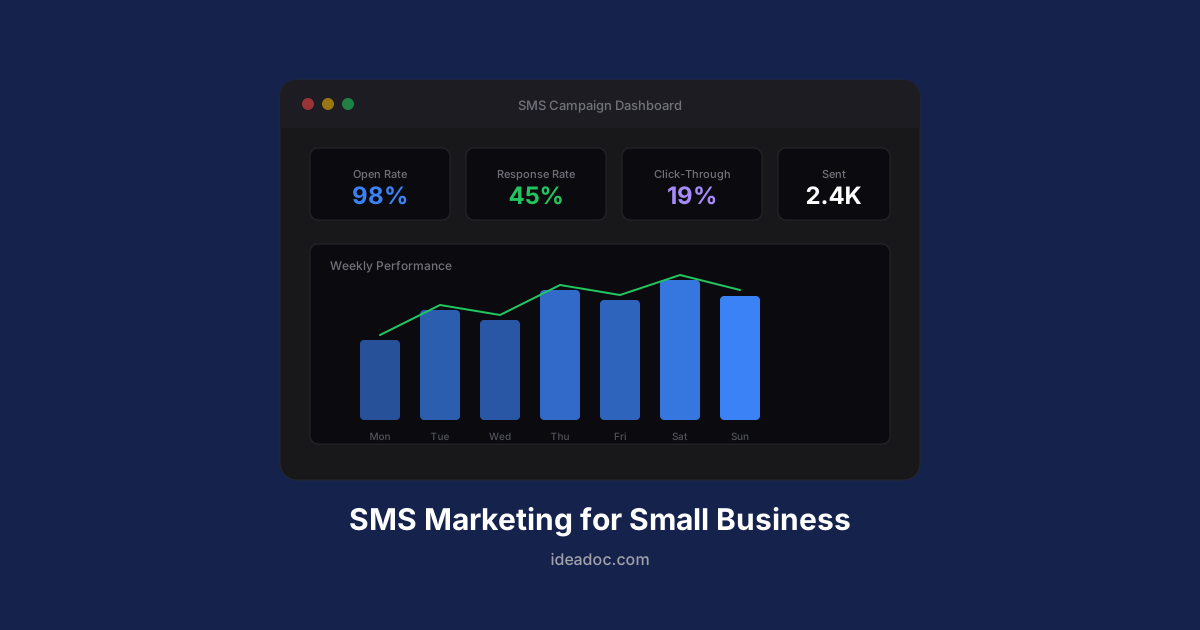
SMS Marketing for Small Business: 98% Open Rates and How to Get Started
SMS marketing delivers 98% open rates and 45% response rates — far outperforming email. Learn how small businesses can use text message campaigns for appointment reminders, promotions, and review requests.
How Missed-Call Text-Back Can Recover $10K+/Year in Lost Revenue
Most small businesses miss 30-60% of inbound calls. Missed-call text-back automatically texts callers you can't answer — recovering leads that would otherwise go to your competitor.
AI Voice Agents for Small Business: Answer Every Call Without Hiring
Discover how AI voice agents help small businesses answer every call, book appointments, and handle FAQs around the clock — without the cost of a full-time receptionist.