
N8N vs Zapier: Which Automation Platform Is Right for Your Business?
An honest comparison of N8N and Zapier for small business automation — covering pricing, flexibility, complexity, and when each platform is the right choice.
Why This Comparison Matters
If you have started looking into automating your business processes, you have probably encountered both Zapier and N8N. They solve the same fundamental problem — connecting your business tools and automating repetitive workflows — but they approach it very differently.
Choosing the wrong platform can mean overpaying by thousands of dollars per year, hitting frustrating limitations as your automations grow, or building workflows on a system that does not fit how your business actually operates.
This is an honest comparison based on building automation systems for dozens of small businesses. Both platforms have real strengths. The right choice depends on your specific situation — your technical comfort level, your budget, your data sensitivity requirements, and the complexity of what you want to automate.
The Basics: What Each Platform Does
Both Zapier and N8N are workflow automation platforms. They connect your business applications — CRM, email marketing, scheduling tools, payment processors, spreadsheets, databases — and move data between them automatically based on triggers and conditions.
For example, when a new customer fills out your contact form, the automation can instantly create a CRM contact, send a welcome email, notify your sales team on Slack, add the customer to a marketing list, and log the interaction in a spreadsheet. Without automation, someone on your team does all of this manually, which takes time and introduces errors.
Zapier is a cloud-hosted platform with a visual interface designed for non-technical users. It has been the market leader in small business automation since 2012.
N8N (pronounced "n-eight-n") is an open-source workflow automation platform that can be self-hosted on your own server or used through their cloud service. It launched in 2019 and has grown rapidly, especially among businesses that need more power and flexibility than Zapier offers.
Pricing: The Biggest Difference
This is where the two platforms diverge most dramatically, and it is often the deciding factor for small businesses.
Zapier Pricing
Zapier charges based on the number of tasks — individual actions within your automations. Every time data moves from one app to another counts as a task.
- Free plan: 100 tasks per month (enough for testing, not for production use)
- Starter: $19.99/month for 750 tasks
- Professional: $49/month for 2,000 tasks
- Team: $69/month per user for 2,000 tasks with collaboration features
- Enterprise: Custom pricing
The task-based model sounds reasonable until you calculate real-world usage. A single lead capture automation that creates a CRM contact, sends an email, notifies your team, and updates a spreadsheet consumes 4 tasks per trigger. If you capture 50 leads per month, that one automation uses 200 tasks. Add appointment reminders, review monitoring, and invoice tracking, and you can easily consume 2,000 to 5,000 tasks per month.
At that volume, you are paying $49 to $149 per month — and the cost scales linearly as your business grows. More customers means more tasks means higher bills.
N8N Pricing
N8N offers two models:
- Self-hosted (Community Edition): Completely free. You install N8N on your own server (a basic cloud server costs $5 to $20 per month) and run unlimited workflows with unlimited executions. No task limits. No per-user fees. No artificial caps.
- N8N Cloud: Starting at $20/month for 2,500 executions, with higher tiers available. Still significantly cheaper than Zapier at equivalent volumes because N8N counts workflow executions, not individual tasks within workflows.
The self-hosted model is transformative for businesses with moderate to high automation volumes. A business running 5,000 automations per month might pay $100+ on Zapier but runs the same volume on N8N self-hosted for the cost of a $10/month server.
Over a year, the savings can be $1,000 to $3,000 or more — real money for a small business.
Flexibility and Power
Zapier's Approach
Zapier prioritizes simplicity. Building an automation (called a "Zap") follows a linear structure: trigger, then action, then action. You select apps from a menu, configure settings through dropdown menus and fill-in fields, and the Zap runs.
This works beautifully for straightforward automations — new email to Slack notification, form submission to spreadsheet, payment received to invoice. Zapier has 7,000+ app integrations, which is the largest ecosystem in the automation space.
Where Zapier struggles is with complexity. Branching logic (if this condition, do this; otherwise, do that) is limited. Looping through lists of data is awkward. Transforming data between steps requires workarounds. Multi-step workflows with conditional paths quickly become difficult to build and maintain.
N8N's Approach
N8N uses a node-based visual workflow editor. Each step in your automation is a node that you drag onto a canvas and connect to other nodes. This might sound similar to Zapier, but the difference in capability is significant:
- Branching and conditional logic is native. You can split a workflow into multiple paths based on any condition.
- Loops and iterations are built in. Processing a list of 100 customer records with individual actions on each is straightforward.
- Data transformation happens inline with JavaScript or Python expressions. You can reshape data between steps without external tools.
- Sub-workflows allow you to build modular automations that call other automations, keeping complex systems organized.
- Error handling is granular. You define what happens when a specific step fails — retry, skip, alert, or run an alternative path.
- Custom code nodes let you write JavaScript or Python when the visual builder is not enough. This opens up possibilities that simply do not exist in Zapier.
N8N has 400+ native integrations — fewer than Zapier, but it includes an HTTP Request node that can connect to virtually any service with an API. In practice, you rarely encounter a tool you cannot integrate.
Data Privacy and Control
This is an increasingly important factor for businesses that handle customer data, financial records, or information subject to industry regulations.
Zapier
All data flows through Zapier's cloud servers. Your customer information, financial data, and business communications are processed on Zapier's infrastructure. Zapier maintains SOC 2 compliance and reasonable security practices, but you are trusting a third party with your data.
For many businesses, this is perfectly acceptable. But for businesses in healthcare, legal services, financial advising, or any field with strict data handling requirements, it can be a compliance concern.
N8N Self-Hosted
When you self-host N8N, your data never leaves your infrastructure. Automations run on your server, and no information is sent to N8N or any third party. You maintain complete control over where your data lives, how it is stored, and who can access it.
This is a significant advantage for businesses that are serious about data privacy or that operate under regulatory frameworks like HIPAA, SOC 2, or GDPR. Your automation consultant can help you determine whether self-hosting is necessary for your compliance requirements.
Ease of Use
This is where Zapier has a genuine advantage.
Zapier is designed so that anyone — regardless of technical skill — can build basic automations in minutes. The interface guides you through each step. Templates for common workflows are one click away. The learning curve is gentle, and you can be productive on day one.
N8N is more powerful but requires more technical comfort. The node-based editor is intuitive once you understand it, but the initial learning curve is steeper. Data transformation, conditional logic, and error handling require some familiarity with concepts like JSON, expressions, and API requests.
For business owners who want to build their own simple automations without help, Zapier is the easier starting point. For businesses working with an automation specialist who builds and maintains the workflows on their behalf, N8N's complexity is invisible to the business owner — they just see the results.
Reliability and Performance
Both platforms are reliable for standard use cases. Where they differ is in edge cases:
- Zapier occasionally has delays during high-volume periods. Free and lower-tier plans run on shared infrastructure, which can result in slower execution during peak times. Webhook triggers are generally fast, but polling triggers (checking for new data at intervals) can have 5 to 15 minute delays.
- N8N self-hosted performance is entirely within your control. If you provision adequate server resources, automations execute instantly. There are no shared infrastructure delays and no artificial throttling based on your plan tier.
For time-sensitive automations — like responding to a new lead within seconds — N8N self-hosted offers more predictable performance.
When Zapier Is the Right Choice
Zapier is the better fit when:
- You want to build automations yourself without technical help, and your needs are relatively simple
- You need a specific app integration that N8N does not support natively and you do not want to work with APIs
- Your automation volume is low (under 750 tasks per month), keeping costs on the Starter plan
- Speed of setup matters more than long-term cost — you need something working today with minimal configuration
- You are testing automation concepts before committing to a more robust platform
Zapier is an excellent tool for getting started with automation. Many businesses begin on Zapier and later migrate to N8N as their needs grow and costs increase.
When N8N Is the Right Choice
N8N is the better fit when:
- Cost efficiency matters — you are running enough automations that Zapier's per-task pricing becomes expensive
- You need complex workflows with branching logic, loops, data transformation, or custom code
- Data privacy is a priority — you want your customer and business data to stay on your own infrastructure
- You are working with an automation specialist who can leverage N8N's full capabilities on your behalf
- You want to scale without scaling costs — unlimited executions on the self-hosted version means your automation costs do not grow with your business
- You need reliable, fast execution without shared infrastructure delays
Why IdeaDoc Uses N8N
Transparency matters, so here is why we build client automations on N8N rather than Zapier.
Cost predictability. When we build a lead nurture system that runs 3,000 workflows per month, we do not want the client's automation bill growing every time their business grows. N8N self-hosted eliminates that concern entirely.
No artificial limitations. Zapier's task limits and feature restrictions at lower tiers force compromises in workflow design. N8N lets us build the right automation without worrying about plan limits.
Data control. Many of our clients handle customer data that should stay on their infrastructure. Self-hosted N8N makes this straightforward.
Flexibility. The workflows we build for small business automation often require complex conditional logic, data transformation, and integration with custom systems. N8N handles this natively where Zapier would require workarounds or higher-tier plans.
Open source community. N8N's open-source model means the platform is continuously improved by thousands of developers worldwide. New integrations and features ship rapidly, and the community provides solutions to edge cases.
That said, we do not believe N8N is universally better. For a business owner who wants to connect two apps with a simple automation and manage it themselves, Zapier's simplicity is a genuine advantage. The right tool depends on the job.
Making Your Decision
Here is a practical framework for choosing:
Choose Zapier if you are doing it yourself, your automations are straightforward, and your volume is low enough to stay on an affordable tier.
Choose N8N if you are working with a specialist, your automations are complex, your volume is significant, or data privacy matters to your business.
Not sure? Start by listing the five automations you want to build. If they are simple connections between popular apps, Zapier will serve you well. If they involve conditional logic, data processing, or will run at high volume, N8N is likely the better long-term choice.
Either way, the important thing is to start automating. The platform you choose matters less than the decision to stop doing manually what software can handle for you. If you are trying to figure out what to spend, our small business AI budget guide covers realistic cost ranges for automation and other AI solutions.
Ready to figure out which automation platform fits your business? Schedule a free automation consultation and we will map out your workflows and recommend the right approach.
Get AI tips for your business
Join small business owners getting weekly insights on AI automation, chatbots, and growth strategies. No spam, unsubscribe anytime.
Related Articles
5 AI Automations Every Small Business Should Set Up in 2026
Discover the five highest-impact AI automations that save small businesses 10+ hours per week — from lead capture to review management.
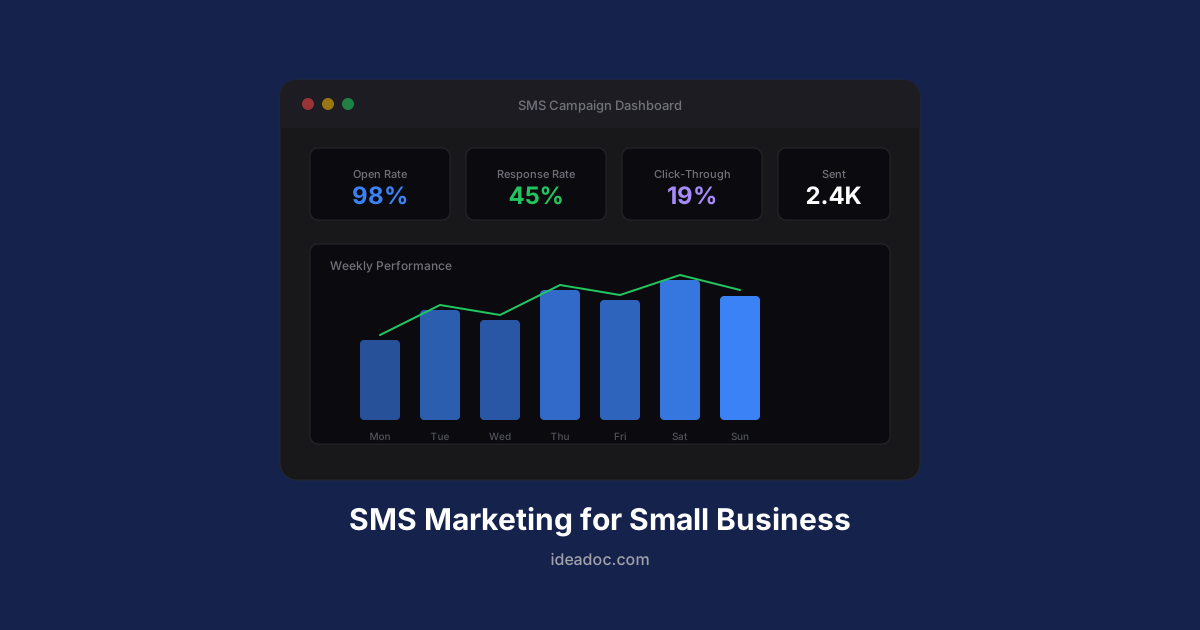
SMS Marketing for Small Business: 98% Open Rates and How to Get Started
SMS marketing delivers 98% open rates and 45% response rates — far outperforming email. Learn how small businesses can use text message campaigns for appointment reminders, promotions, and review requests.
How Missed-Call Text-Back Can Recover $10K+/Year in Lost Revenue
Most small businesses miss 30-60% of inbound calls. Missed-call text-back automatically texts callers you can't answer — recovering leads that would otherwise go to your competitor.