
How AI Chatbots Actually Work: A Business Owner's Guide
A plain-English explanation of how AI chatbots work, how they learn from your business data, and what separates a great chatbot from a frustrating one.
Why Understanding the Basics Matters
You do not need a computer science degree to use AI chatbots effectively in your business. But understanding the fundamentals — at a conceptual level — helps you make better decisions about what to buy, what to expect, and how to evaluate whether a chatbot is actually working.
Too many business owners get sold on flashy demos without understanding what is happening under the hood. This leads to mismatched expectations, wasted budgets, and the conclusion that "AI chatbots do not work for my business." The reality is that chatbots work extremely well when they are built correctly and trained on the right data.
This guide breaks down how modern AI chatbots function, in language designed for business owners rather than engineers.
The Core Technology: Natural Language Processing
At the heart of every AI chatbot is Natural Language Processing, or NLP. This is the technology that allows a computer to understand human language — not just keywords, but meaning and intent.
When a customer types "Are you guys open on Sundays?" the chatbot does not simply search for the word "Sunday" in a database. It understands that the customer is asking about business hours for a specific day. This means the chatbot can also handle variations like "What are your weekend hours?", "Do you work on the weekend?", or "Is the shop open this Sunday?" — all of which express the same underlying intent.
NLP works through several steps that happen in milliseconds:
- Tokenization: The message is broken into individual words and phrases
- Intent recognition: The system identifies what the customer is trying to accomplish (check hours, place an order, get a price quote)
- Entity extraction: Key details are pulled from the message (a specific day, a product name, an appointment time)
- Context tracking: The system remembers what was said earlier in the conversation to understand follow-up messages
The result is a chatbot that can carry on a genuine conversation rather than just responding to rigid commands.
How Chatbots Learn from Your Business Data
A generic chatbot is not very useful. What makes a business chatbot valuable is training it on your specific data — your menu, your services, your pricing, your policies, your FAQs, and your brand voice.
This training process works differently depending on the type of chatbot:
Knowledge Base Training
The most common approach for business chatbots is providing a curated knowledge base. You supply documents, web pages, FAQ lists, and product information. The chatbot indexes this content and uses it to answer questions accurately.
For example, a dental practice might provide its list of services, insurance policies, office hours, provider bios, and common patient questions. When a website visitor asks "Do you accept Delta Dental?", the chatbot pulls the answer directly from the practice's verified information — not from a guess.
Conversational Training
Beyond factual knowledge, chatbots are trained on how to have conversations. This includes the tone and style of responses (professional, friendly, casual), how to handle situations where the answer is unclear, when to escalate to a human, and how to guide customers toward conversion actions like booking an appointment or requesting a quote.
This is where working with an experienced AI chatbot provider makes a significant difference. The conversational design — how the chatbot flows from greeting to resolution — is often more important than the underlying technology.
Continuous Learning
Modern chatbots improve over time. They track which questions they could not answer, which conversations ended with the customer leaving unsatisfied, and which response patterns lead to successful outcomes. This data feeds back into the training process, and the chatbot becomes more capable with every interaction.
Multi-Channel Deployment
One of the biggest advantages of modern AI chatbots is that they work across multiple channels from a single system:
- Website widget: A chat window on your site that engages visitors in real time
- Facebook Messenger: Responding to customers who message your business page
- Instagram DMs: Handling product questions and service inquiries
- SMS/Text messaging: Conversational text interactions with customers
- WhatsApp: Popular for businesses with international customers
- Google Business Messages: Responding to customers who find you through Google Search or Maps
The chatbot maintains context across channels. If a customer starts a conversation on your website and follows up via text message, the system recognizes them and continues the conversation seamlessly. This omnichannel capability is something that would require a dedicated team to handle manually.
What Makes a Good Chatbot vs. a Bad One
Not all chatbots are created equal. Here is what separates effective business chatbots from the ones that frustrate customers and waste your money.
Good Chatbots
- Understand context and nuance. They handle follow-up questions, pronoun references ("How much is it?"), and multi-part requests without getting confused.
- Know their limitations. When they cannot answer a question confidently, they say so and offer to connect the customer with a human rather than making something up.
- Respond in your brand voice. A law firm's chatbot should sound different from a pizza shop's chatbot. The tone, vocabulary, and formality should match your brand.
- Complete tasks, not just answer questions. Great chatbots book appointments, capture lead information, process simple orders, and trigger automated follow-up workflows. They drive business outcomes.
- Provide fast, accurate responses. Response times under two seconds with information pulled from verified business data. No hallucinated answers.
Bad Chatbots
- Rely on rigid decision trees. If the customer's question does not match a pre-programmed path, the bot breaks down. These are the "I did not understand that, please choose from the following options" chatbots that everyone hates.
- Make up answers. Some chatbots generate plausible-sounding but incorrect responses when they do not have the right information. This is worse than no chatbot at all — it actively damages customer trust.
- Lack a human fallback. Any chatbot that traps customers in an endless loop without offering a way to reach a real person will drive customers away.
- Ignore conversation history. Asking the customer to repeat information they already provided is a fast way to lose them.
- Sound robotic or generic. Responses that feel clearly automated, with no personality or business-specific context, make your company look like it does not care about customer experience.
Common Misconceptions
"Chatbots are just glorified FAQ pages"
This was true five years ago. Modern AI chatbots handle dynamic conversations, integrate with business systems, and complete transactions. They are interactive tools, not static knowledge bases. A well-built chatbot can guide a customer from initial question to booked appointment in under two minutes.
"Customers hate talking to bots"
Customers hate bad bots. Research consistently shows that customers prefer chatbots for routine interactions because they provide instant responses without wait times. The key is quality — a chatbot that actually resolves the customer's issue quickly is preferred over waiting on hold for a human. Businesses like restaurants have seen major improvements in customer satisfaction and response times after deploying well-trained chatbots.
"AI chatbots will replace my staff"
Chatbots handle the repetitive, routine interactions that take up a disproportionate amount of your team's time. This frees your staff to focus on complex situations, relationship building, and high-value work that genuinely requires human judgment. The best implementations are a hybrid model where AI handles volume and humans handle complexity.
"Setting up a chatbot is a huge IT project"
Modern chatbot platforms deploy in days, not months. The biggest investment is not technical — it is preparing your knowledge base and defining your conversation flows. The technology setup, integration with your existing systems, and channel deployment are handled by your provider.
"All chatbot platforms are basically the same"
The gap between a well-built custom chatbot and a generic template is enormous. Custom solutions are trained on your specific data, designed for your specific customer interactions, and integrated with your specific business tools. Templates handle the generic case. Your customers are not generic.
How to Evaluate a Chatbot Solution
If you are considering an AI chatbot for your business, here are the questions to ask:
About the technology:
- Is the chatbot powered by modern large language models, or is it a rules-based system?
- Can it handle follow-up questions and multi-turn conversations?
- How does it handle questions it cannot answer?
About customization:
- Will it be trained on my specific business data?
- Can the tone and personality be tailored to my brand?
- Does it integrate with my existing tools (CRM, scheduling, POS)?
About deployment:
- Which channels does it support (website, social media, SMS)?
- How long does setup take?
- What does the ongoing maintenance look like?
About performance:
- How is accuracy measured and reported?
- Can I review conversation logs?
- How does the system improve over time?
A thorough AI consulting engagement can help you evaluate these factors against your specific business needs before you invest in a solution.
Where Chatbots Are Headed
The technology is advancing rapidly. Within the next year, expect to see business chatbots that handle voice and text interchangeably, process images (a customer photographs a problem and the chatbot diagnoses it), and proactively reach out to customers based on behavioral triggers rather than waiting to be contacted.
For small businesses, the practical implication is clear. AI chatbots are transitioning from "nice to have" to "table stakes." Your competitors are deploying them. Your customers are getting accustomed to instant, intelligent responses. The businesses that implement quality chatbot solutions now build a compounding advantage in customer experience and operational efficiency.
Taking the First Step
You do not need to automate everything at once. Start with the highest-impact use case for your business — usually answering the questions your team gets asked ten times a day. Build a chatbot that handles those interactions flawlessly. Measure the results. Then expand.
The goal is not to remove the human element from your business. It is to make sure every customer gets an instant, accurate, helpful response — whether a human is available at that moment or not. That is what good AI chatbots deliver.
Ready to explore what a custom AI chatbot could do for your business? Get in touch for a free consultation and we will walk through your specific use case together.
Get AI tips for your business
Join small business owners getting weekly insights on AI automation, chatbots, and growth strategies. No spam, unsubscribe anytime.
Related Articles
AI Chatbots for Restaurants: How to Handle Orders, Reservations, and FAQs 24/7
Learn how restaurant AI chatbots handle online orders, reservations, and customer questions around the clock — reducing missed calls and boosting revenue.
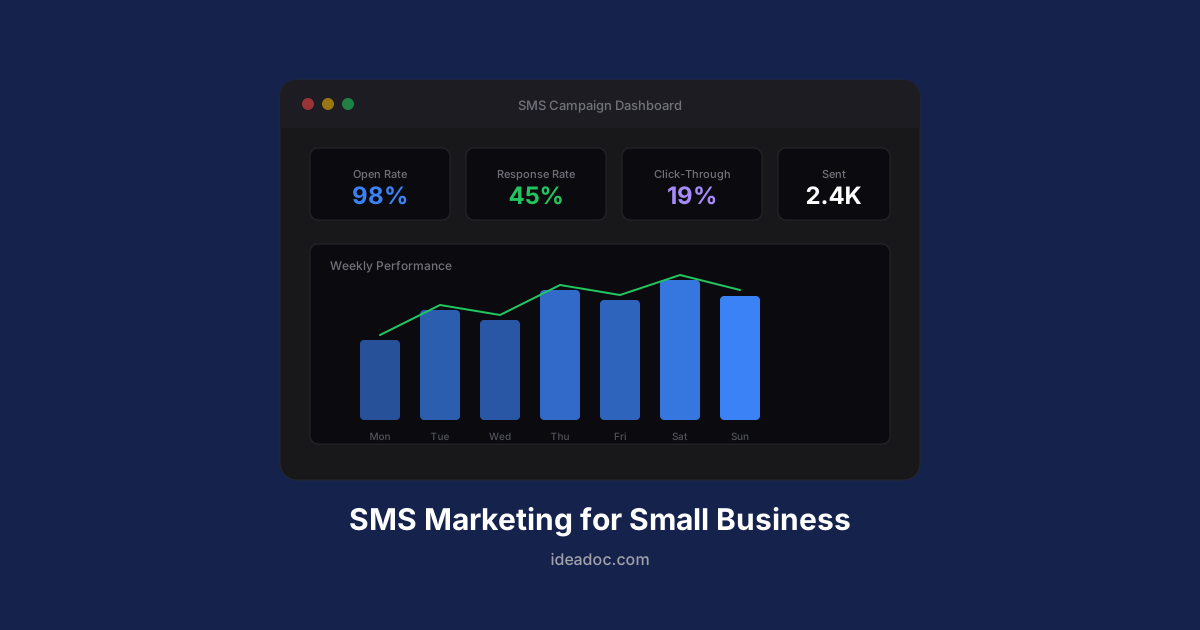
SMS Marketing for Small Business: 98% Open Rates and How to Get Started
SMS marketing delivers 98% open rates and 45% response rates — far outperforming email. Learn how small businesses can use text message campaigns for appointment reminders, promotions, and review requests.
How Missed-Call Text-Back Can Recover $10K+/Year in Lost Revenue
Most small businesses miss 30-60% of inbound calls. Missed-call text-back automatically texts callers you can't answer — recovering leads that would otherwise go to your competitor.